After 35 years, the Utah Division of Technology Services has exited its 1987 primary data center. The building served a long, useful life. A couple of years ago, the Utah Legislature decided it was time for another Capitol Hill rebuild. The old State Office Building where I began my career with the state in 1989 was to be demolished and with it, the non-descript one story data center behind it. In 2009, shortly after the consolidation of all state IT into a single department, we moved all server operations from 38 different locations into that data center. Beyond that, we had a secondary data center located in Richfield to provide emergency services and business continuity operations for the state. With the consolidation, we also virtualized over 80% of the server farm, reducing the number of services substantially. Even though that move saved the state a lot of money, I think it actually helped delay many aspects of our cloud strategy which was published in that same year.
Back to today... the data center move is essentially complete. There are some servers to decommission, a few network connections to complete, and the final shutdown which will occur over the next few weeks. Over 900 servers were moved to the cloud during the last 10 months. Dan Frei, our CFO, and Mark Schultz did a tremendous job of mobilizing the whole operation. The whole thing was completed on-time and under budget. It had a tight deadline due to DFCM's target for demolishing the State Office Building. Capitol Hill will take on a new look. DTS has been operating out of the Taylorsville Office Building for over a year now and the remaining data operations are in a much smaller footprint here in this building.
At the same time as the data center exit, DTS has supported the moves of various state agencies to new locations, wiring and provisioning a new state prison, supporting thousands of remote workers who moved out of the office during the pandemic, the transition to a new administration and a new department, while maintaining support for thousands of employees, over 1600 information systems and a similar number of digital services, along with 100s of new projects. The teams have all done a great job: networking, hosting, cloud operations, devops, etc.
It's time for a new era. We will continue to build on this effort, with cloud-based applications, increased connectivity, and a remote work environment. Expect great things.
Digital Government has become firmly entrenched as the way to do business for states in the 21st century. Although I have continued to work on new initiatives over the past two years, there is now so much content on the subject that I have not felt compelled to add to all the noise. I can leave that to groups like 18f.
Now we have something new. Over the past few weeks, government IT has sprung into action in response to the spread of the COVID-19 virus around the world. States have been meeting regularly to discuss their responses and the critical use of technology as an integral factor in our ability to continue working throughout the crisis.
The response is bimodal. First of all, state IT agencies provide important utility-type services that keep government running: network connectivity, productivity support, data centers or cloud hubs that enable large-scale government services like unemployment, public health, and education to scale to the public. The biggest disruption to these services was to network connectivity and it was swift and dramatic. Overnight, IT needed to provide secure home connectivity to thousands of workers who were sent home. In Utah, this meant providing VPN service to thousands of new remote workers. Fortunately, Lt. Governor Spencer Cox had already supported a growing pilot of telecommuters that were already comfortable with the digital workplace.
Utah migrated to Google Apps for Government in 2012. In 2009, the state first developed a plan to implement a hybrid cloud environment. Workers began to increase their mobility beginning in 2007, when they rolled out the first government iPhone app and adapted to the use of tablets with the release of the Utah iPad Guide a few years later. These early movements towards developing a digital workplace and digital dexterity among the state workforce paid off during the COVID-19 response.
Through the first few weeks of the pandemic response, an all-hands team met at least daily to coordinate the support issues associated to working with a new remote workforce. The team met using Google Meet and was able to quickly coordinate the response and address any issues that surfaced.
The second part of the response or mode 2, involved the creation of new services or capabilities unique to the pandemic itself.
This was my original outline of our response after about a week.
Agencies then identified additional needs as the pandemic progressed. We needed a more robust dashboard with detailed information on hospital rooms, ventilators, PPE availability, etc. with detail at the county and local level. We began to work with the larger IT community in Utah. Silicon Slopes, working with the Governor's Office, developed the TestUtah application that surveyed thousands of Utahns for possible symptoms of the virus, while also supporting new drive-up test facilities to expand testing availability across the state.
The Division of Emergency Management worked with UDOT and DTS to stand up entry.utah.gov, a way to survey anyone entering the state, either by driving or through the airport.
We're not done yet and this post is certainly not comprehensive of the state response. I'm looking forward to a few updates in the next few weeks
2018 marks 25 years since I created my first government website. A quarter of a century.
The past year has been full of planning, strategizing and implementing new digital government services within a context that is focused on a new technological nexus that includes IoT, artificial intelligence, cloud services, blockchain, and other promising developments.
Just this morning, the Utah Data Research Center posted its new site with promise of more robust visual analytics supporting Utah's efforts to improve educational outcomes with more effective use of longitudinal data.
We have been focusing efforts to promote a platform model of digital government that is much more holistic in its approach. Our efforts are working towards incorporating Gartner's approach to delivering a Digital Government Technology Platform built on a mesh app and services architecture (MASA).
One of the key components will consist of a reliable, pervasive identity and access architecture that will enable us to provide more seamless access to business and citizen services securely and efficiently.
In 2017, we spent a great deal of time to define and improve our user experience throughout the Utah.gov domain that we now use as a brand not only for web and mobile experience, but for a growing number of platform services, whether that be on Amazon Alexa, Google Home, Apple Watch, or other third party platforms. We were excited when the Center for Digital Government recognized the State's accomplishments in attempting to build and enhance the multi-channel experience, but also understand that there is much that still remains to be done to achieve our goals in this area.
Moving forward, I expect to see increased emphasis on 3 components of the digital government platform. We have reached a high level of maturity in delivering individual digital services as reflected in the upper left corner of the platform model. We have really just begun on building out the ecosystems and IoT platforms. We have approved standards in our architecture review process that can enable this to happen, but must do a better job of providing an integrated architecture that will underlay these components and enable them to be better supported by the Data and Analytics or "Intelligence" platform.
I had a discussion last week with leaders from US Ignite and Utah Ignite to promote a more coordinated approach to IoT and Smart Cities in Utah.
Last week, at the Utah Digital Government Summit, we announced the availability of a great new Alexa skill now available on the Amazon Echo. Actually, Utah has published two new skills for the popular device: Utah Fishing which lets you ask Alexa how fishing is at lakes and rivers across the state of Utah and Utah Public Meetings which helps you keep up with important meetings, events, and decisions in your community.
I've already had people tell me they went fishing for the first time in years after engaging with the Utah Fishing Skill. Once you have Alexa open Utah Fishing, you can ask about almost any body of water in the state and Alexa will respond with the latest fishing report (these are usually updated weekly). Based on the popularity of the Utah Wildlife mobile app, I'm expecting this new fishing skill to be similarly popular on this emerging platform.
Be sure to install these new skills on your Echo right away and then go enjoy some of Utah's great blue ribbon fisheries.
I've seen a few interesting wearable apps out there for government, but not many. I'm now testing a new Apple Watch app that we're developing with Utah Interactive that makes a lot of sense. We had to update our existing Bill Watch app to Swift in order to make it available on the watch. The app keeps users informed of any changes made to bills during the 45-day Utah legislative session. The existing mobile app was a game-changer for bill-followers during the session where about 1000 bills are discussed during this compressed time frame. The watch will make it even easier to get notified and check status while so many other things are going on.
We're also working on some other projects in this area.
After 15 years, the Utah Product Management Council is ready for a new life. The Council has helped Utah become a leader in Digital Government over that period and is ready to help the State transition into a new period that will feature artificial intelligence, wearable technologies, and personal digital assistants.
Agency efforts to transform government services will be led by Digital Experience Managers who will combine a focus on strategy, technology, and process to deliver highly engaging digital experiences to Utah citizens.
The focus of the Utah Digital Experience Management Council (UDEMC) will include:
Service Integration We will find ways to integrate service delivery and provide greater personalization so that users can better discover new services and information that is relevant to them.
Omnichannel We will expand our focus to deliver products across the growing spectrum of platforms and devices that are being used by our citizens, including wearables, IoT devices, etc.
Enterprise Platform ICAM and PaaS services will be more standardized across the state enterprise to increase our ability to deliver services quickly and efficiently.
Open Data We will continue to enhance Utah's open data capabilities.
User-Centric Services will focus on the needs of individual users, not on the agency delivering the service.
Accessible We will not lose sight of the need to make new services and platforms accessible to all users.
Artificial Intelligence Utah will continue to explore ways to integrate AI and other emerging technologies into the service delivery process to improve service and create new efficiencies.
Seventeen agencies were represented as we agreed to work together to "radically improve upon the experience of government, and push the boundaries of how services are delivered."
Utah.gov will continue to be a primary delivery channel for services, but will expand as a brand for new kinds of services. For example, we are currently working on several new wearables applications and integration with digital assistants, including new services for the Alexa platform.
New technologies and innovations are changing the nature of digital government in 2015. Digital government has become transformative in nature and provides regular opportunities to change the way government interacts with the public. This is as true in Utah as it is anywhere in the world. Last week, I meet with a team of bright young executives from Prime Minister Modi's Digital India initiative and we had a great exchange of ideas. I was extremely impressed to see their level of sophistication in areas such as open data.
If you've followed my blog, you know that each December since 2002, I've put together a top 10 list of the best of egov in the state of Utah. It helps me to review some of our key accomplishments, track progress over time, and give some additional thought to what's ahead. That's still what I'm most excited about and 2016 will be a great year.
Two new mobile apps for the Utah Department of Workforce Services Utah has had tremendous success using online services to connect job seekers with potential employers. This has helped the state maintain one of the lowest unemployment rates in the country. Recently, the Department of Workforce Services created two new mobile apps: Hire Utah, which lets employers post job opportunities from their mobile device and Utah Jobs, which helps qualified applicants find the job they are looking for.
Utah Transportation and the Internet of Things The Utah Department of Transportation (UDOT) is one of several agencies finding new applications for the Internet of Things. For example, UDOT recently incorporated a real-time snow plow tracking feature into it's web and mobile traffic information applications. In addition to location tracking, the vehicles also send real-time vehicle status information which will save the state thousands of dollars in vehicle maintenance costs. The Department of Technology Services (DTS) is working on a more comprehensive Internet of Things Strategy for the state.
The rollout of a new open data portal. DTS unveiled the state's new open data catalog on January 1, 2015 to begin the new year. By December, the portal had over 1,800 data sets and over 3 million page views.
Creative new business websites and services Just check out this new Silicon Stories website and you'll get an idea of what I'm talking about.
NASCIO holds its annual conference in Salt Lake City The National Association of State CIOs brought its annual meeting to Utah in 2015 for the first time. There were some great presentations from Utah SMEs, including CIO Mark VanOrden who retired in November, UDOT Director Carlos Braceras, and Purchasing Assistant Director Jennifer Salts who shared a lot of great tech innovation emanating from Utah.
New uses of GIS services like Utah crash mapping State agencies created dozens of new interactive maps that help users understand what is happening in the state and aid agencies in their ability to address a wide variety of challenges.
Publishing of Utah education data Utah's Educational Data Gateway made substantial strides in 2015, providing more information on school performance.
Increased use of business intelligence dashboards and analytics Utah is working to become a data-driven government, making better use of data and analytics for business decisions.
The new Utah.gov portal Here's the April press release announcing the 2015 version of Utah.gov
Silver 2.0 Silver 2.0 is the new source for Utah birth and death certificates and introduced several new innovations in the way digital IDs are verified.
There is still a lot to look forward to. 2016 will be a great year!
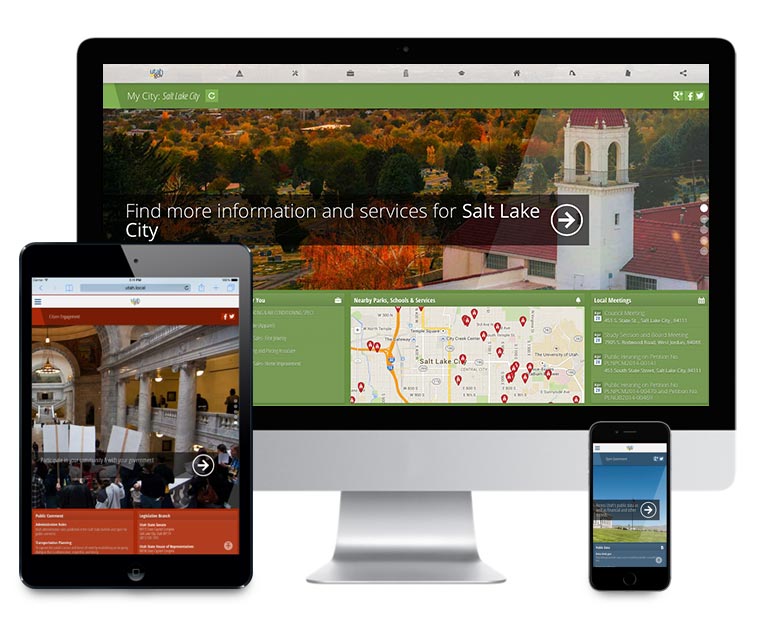
Just about a month ago, we published a new version of the Utah.gov portal.
The new site was part of an ongoing process to add more context, to become more responsive and to continue to improve service to the Utah public. We hope that works. It integrates more social media and context rich information than ever before, providing a variety of micro-experiences as the user scrolls down the page. The site builds on previous development while significantly adding to the overall user experience. Search is still prominent, but the scroll puts much more information in front of the user.
The design is very much a mobile-first design focused initially on making it work for tablet and smartphone users which are a fast growing segment of those who access the site looking for government services and information. In the past 30 days, we have had almost 900 different mobile device types access the portal which presents a challenge to ensure the quality of the user experience.
Our user base has evolved significantly over the past year. With the improved economy (Utah's unemployment rate is down to about 3.4%), a lot fewer users are coming to the domain to look for jobs or unemployment benefits. Those users have dropped off by over 50%. We continue to monitor analytics to ensure that we are delivering the content that users are looking for.
Last week, we turned our attention the the Utah Digital Government Summit and had a great event. We hope that by bringing everyone together for a day, that we can maintain the momentum that we have in delivering government services digitally. Thanks to everyone who participated and to eRepublic for coordinating the event!
The CPPA also released their new study on the effectiveness of digital government in Utah and its acceptance by the public. Check out the link in this tweet:
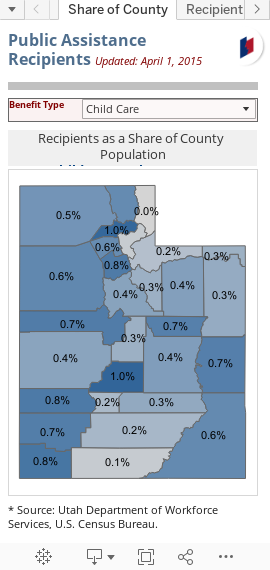
The Utah Department of Workforce Services provides some of the most important state services. It is an agency that understands data and its importance in making sound decisions. The Department just announced a new Workforce Statistics Dashboard.
The Dashboard uses Tableau to visualize data such as labor market information, public assistance recipients, poverty and homelessness, and job growth programs. The tool provides the ability to take a more granular look at these issues, either statewide or at the county level.
Here's an example of just one portion of the dashboard which is interactive with the user.
The dashboard also provides download capabilities making it another piece of the state's overall commitment to open data.
After less than two weeks, we have had over 51,000 page views of the new Utah Open Data Catalog. It is generating a lot of interest and we have barely begun. I expect to eventually see a lot more data and some very large datasets.
Filters and conditional formatting are a very important feature when we start looking at these very large data sets. The user may want to visualize just a small portion of the whole set.
Here's an example. Our UCAS grades include data for all Utah schools. With this dataset, I can quickly limit the data to a specific subset; in this case, just elementary schools and only in the Alpine District. Socrata gives me the ability to visualize the data based on specific conditions, so I have assigned lavender to schools that received an "A" grade and a lighter blue to those that received a "B". Here's what you get:
The new Utah Open Data Catalog is now live at opendata.utah.gov. We will also be updating Data.Utah.gov this month with a new design and connecting it dynamically to the catalog. The catalog is built on Socrata's open data platform and provides us with a lot of new capabilities and flexibility. We will be presenting it to the Utah Transparency Board tomorrow.
UPDATE: We did an interview with Fox13 news on January 7. Here's a clip (you'll have to wait through a brief commercial):
Although the catalog has over 800 datasets and lots of charts and maps, there is still A LOT of work left to do. We want all open data available here for the state and that requires lots of cooperation from state agencies. We also want to work with local governments on their open data initiatives and are already partnering with Salt Lake City on a micro portal.
Users will be able to embed charts, graphs, and maps using data and functionality from the catalog directly in any website. Here's a map of DABC licensees in Utah (Park City).
Today, digital is embedded into every aspect of government in Utah. It is the most effective way for reaching out to the public we serve in ways that could never be achieved before. Our services, our information; legislative, executive and judicial branches of government all use digital technologies to enhance the way the operate, to increase efficiencies and to interact in new and exciting ways.
Utah has become a truly digital state, but before I go further, I want to share a video about our state that was posted to YouTube yesterday.
In addition to being a state of great natural beauty, Utah is a state of hard-working people that have embraced the transition to digital and are now using it to create an advanced economy that leverages technology and innovation in numerous ways.
In 2014, 12 of every 13 Utah households have access to broadband. Almost every home has a PC and the state is increasingly mobile. We implemented a new Utah.gov portal design to reflect these realities using bold graphics and enhanced focus on interactive services.
Now, here is my top 10 list for 2014 (the 13th version, beginning in 2002):
Progress in Mobile Design. Following the release of our Mobile Strategy in 2013, we have been tracking our progress in adopting responsive design. We have gone from 13% to 60% of sites with responsive design and utilization has continued to grow. That is no small task for a domain with over 30 million pages of content and over 1100 interactive online services. A couple of examples of these new sites include:
The Digital State. The Center for Digital Government biannual survey is a comprehensive look at about everything the 50 states do with regard to digital technology. Utah was 1st in two of six categories: Enterprise ICT and Citizen Engagement. This is what they said after Utah was again recognized with an "A" grade:
"The public expects to be able to interact with their government using new convenient technologies, and with the new services that states like Utah are delivering, that expectation is being met, Sander said. “Particularly Utah has done an awful lot with raising the bar on electronic services, on direct citizen engagement, not just from the push information at them standpoint, but actually opportunities with them to engage and transact and do business with government,” he said. “All three of the As have done a lot in that regard.”
Legislature & Tech: the Online Democracy Award.
The Utah Legislature continues to fine new ways to use technology to improve public participation, collaborate more effectively, and promote open government. In 2013, the Utah Bill Watch app was a big hit. Improved website design and service delivery was also effective:
From StateScoop: "The Utah Legislature’s website took home the 2014 Online Democracy Award for producing a superior legislative website during the National Conference of State Legislatures’ (NCSL) 2014 Legislative Summit in Minneapolis."
Open Data Progress Shepherded by Senator Deidre Henderson and the Utah Transparency Board, SB70 passed the legislature with funding for more transparency and openness, including funding for a new open data portal which will go live on January 1, 2015 and a new central portal for open records requests that will be managed by the Utah State Archives.
A New Mobile App for Hunting and Fishing. In October, the Division of Wildlife Resources, working with Utah Interactive, produced a new mobile app for iOS and Android that made a lot of hunters and fisherman happy. It produced 7,000 downloads in just a few days. Just this week, it was named the best mobile government app of 2014!
A record number of users access the Utah.gov domain and its services. The people of Utah showed their approval of Utah's online government initiatives with a record number of unique visitors in 2015. This has produced 637 million page views in 2014.
Success with Google+ and Social Media. The state's Google+ page now has over 230,000 followers providing a great new channel for content distribution and feedback. In July, PTI announced that Utah received its 2014 Web 2.0+ award.
Utah Big Data Competition Five departments, including Technology Services, UDOT, the Departments of Health, Environmental Quality, and Public Safety teamed up with Big Data Utah and the Utah Hadoop User Group for a big data competition to look at air quality in Utah. After 10 weeks of training, 6 teams worked to analyze over 400 separate datasets to develop analysis of Utah's air quality and inversion challenges.
New website and online services for the Utah Department of Agriculture and Food. UDAF had a busy year, producing a nice upgrade the Utah's Own website, a new mobile app for food safety inspections, and new online services. With the new services in place, beekeepers can update the locations of their hives online, companies that have any type of license with UDAF can pay for multiple license applications and renewals in one batch transaction, and first time license applications can be submitted electronically. While the hive registration service only benefits beekeepers, the two licensing services can benefit all companies that have licenses or registrations with UDAF.
New DHRM website and Employee Gateway. Early in the year, the Department of Human Resource Management created two great new websites, enhancing the way the Department interacts with jobseekers and also creating a great new venue for employees to receive and track benefits and other information related to state employment. Both sites are excellent examples of responsive design for mobile users.
This is the first of three posts that I commit to do before the end of the year. I want to discuss some of the things that we have been doing over the past year. Then, I will complete my annual evaluation of the top 10 accomplishments for digital government in Utah for 2014. I've been doing this since 2002 when I first started to blog and I'm not quite done. Finally, I want to look ahead at 2015 and discuss some of the technologies that will be critical to the future of digital government, not just in Utah, but anywhere.
I'm still posting stuff on a daily basis. Regular updates on Twitter at @dfletcher.
There is so much more great content available about digital government now that I don't spend time generating as much of my own. And the range of activities that digital government has evolved into has grown. Open data, internet of things, cyber security, etc. are all critical components of what we have to include going forward. At the state level, this covers a tremendous amount of territory and without new resources we have to be increasingly efficient in the way we do things. Here in Utah, with one of the fastest growing populations in the US, most new dollars go to education, where the demand is the greatest.
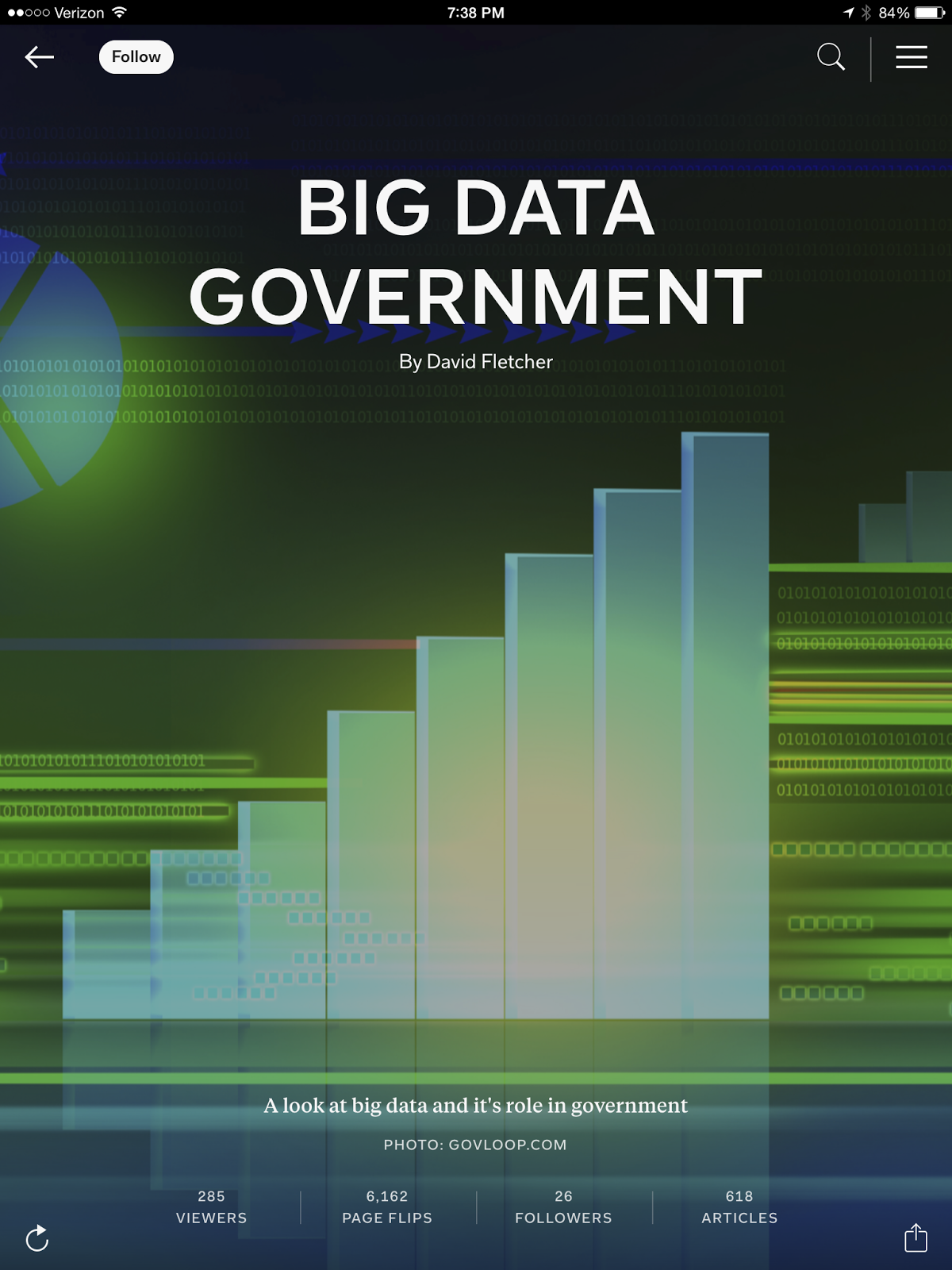
Big Data is one of the areas where we really need to improve our expertise in government to ensure that we are getting the most out of our resources and really utilizing them effectively. With that in mind, I created a new Flipboard a few months ago specifically focused on big data in government. Earlier this year, the state partnered with Big Data Utah, a Geek Events user group, to support a big data competition on air quality. With our high mountain valleys and regular winter inversions, air quality is a major quality of life issue. We had about six teams work on 300-400 data sets in a big data environment and develop some really great proposals. We are working on a business case to address big data more effectively as a state enterprise looking at a wide range of government-related issues.
Over the last 20 years, I have been fortunate to interact with many digital government employees from around the world, including many in Spain and Latin America. With that in mind, and with the growing interest among Spanish speakers in digital government and open data, I also created a Flipboard aggregation of news about the topic in Spanish called Gobierno Digital. It keeps me up to date on developments in those parts of the world, many of which are quite innovative. I have, for example, been quite interested in what Mexico is doing with its Estrategia Digital Nacional, hoping that it can have a positive impact on the country. Alex Howard, aka @digiphile, recently did a great interview with national coordinator @alelagunes. Barcelona, Spain continues to impress me with its innovation culture.
Last spring, not long after Utah developed the Ontime.Utah.gov app for Google Glass with Utah Interactive, there was a huge amount of interest in wearable technology. I did interviews with Chris Dorobek, Government Technology, Mobile Marketer, and others. Since that time, the interest has tapered off substantially. Months later, Glass is still in open Beta, and the future seems a little uncertain. Some suggest that it is a failed experiment, although others affirm that Glass will return in 2015 with a new platform. Regardless, wearables are a piece of the future, particularly with a nationwide effort to equip law enforcement with new body cams.
Last week, the UN published it's 2014 survey on e-government. I've been more than a little interested on how this one would look at the world of egov. The Obama administration has placed a fair degree of emphasis on digital government, including important new aspects such as mobile services and open data. Nevertheless, as Craig Thomler points out in his analysis of national trends, the US has been on a regular decline according to the UN when compared to other top ranked egovernment nations.
The question for US egovernment evangelists, is "why is this the case?" and "what are the implications?" Next we need to determine what we can to about it and make the necessary efforts to improve the way we are delivering information and services, if we determine that the implications are, at all, significant. I pay attention to third party assessments like this because they not only impact public sentiment, but also provide an opportunity for improvement.
Take a look at Thomler's chart showing how the US is trending:
Another important question to ask is "what are nations like Singapore, Australia, and South Korea doing well that we should be understanding and learning from?" Why is it that the UK, which vowed to become the global leader in digital government has also seen a decline in the survey? Estonia, which many see as a global leader in egovernment innovation is still only ranked #15. Spain a country which fell out of the top 20 in 2012 after being ranked #9 in 2010, is back in at #12. Kudos to all my friends making egovernment in Madrid, Barcelona, and beyond.
I still have a lot of work to do in going through the survey, understanding its findings, and determining how I can incorporate its recommendations into my specific microcosm, which is the digital government of the state of Utah. I expect and hope to find some good ideas.
The survey calls for a paradigm shift within the public sector which incorporates the following ideas:
Become catalysts for change, instead of mere service providers
Operate in an integrated, collaborative manner across departments and agencies
Become pro-active instead of reactive anticipating problems
Transform mind-sets and build a culture of collaboration, transparency, and accountability
I can point to ways where we have been working on and seen progress in every recommendation made in the survey, but I can also easily point out areas where we fall short of perfection, and until we reach that objective, there is still work to be done.
Utah recently completed a significant upgrade to its portal, Utah.gov. At first, you will probably not realize how much has changed just by looking at the main page. Yes, we were able to find a light weight, high resolution video and HTML5 gives us the ability to put it right there in the background without any significant impact on performance. You'll see some new infographic imagery in the drop-down menus that give you a hint of what you'll find on the secondary pages, which underwent the biggest transformation.
The secondary pages are all carefully aligned using a twelve column grid structure with HTML5 that supports optimal responsive design on smart phones, tablets, as well as PC's and laptops.
Each secondary page has a custom-designed infographic that demonstrates alignment with State policy goals and objectives. We have increased the use of maps, social media, open data, etc., not just on any single page, but throughout the site. Our integrated master data index (MDI) allows us to use any one or category of resources in new ways anywhere where it makes sense to enhance the user experience.
Our outstanding design staff has added all new scalable iconography that improves the overall design of the site, while making it easier to discover what the user is looking for.
Using the MDI, we have added new categories of content, such as a new page for annual reports across the state. Take a look:
Our annual updates to Utah.gov are paying off more than ever before. In March 2014 alone, we had 1,780,859 unique visitors and over 65 million pages views, more than ever before. In 2013, Utah.gov processed over 32 million online transactions, saving state government over $400 million. Even more important, we were able to save Utah citizens and businesses millions of hours in valuable time, while improving service and satisfaction.
One of the biggest trends in 2013-14 has been the growth in the number of mobile users of Utah.gov. For this reason, we have taken a mobile-first approach to design, making sure that the site is acceptable to the hundreds of thousands of Utahns who access the site from a smart-phone or tablet. The portal is fully optimized for these users and the number of department-level websites now using responsive design is 5x what it was at the beginning of 2013.
Utah's egovernment service providers are fully dedicated to delivering the best to Utah citizens. We support Governor Herbert's goals of improving service, providing better education, and making Utah the #1 state for business in the country.








.PNG "Utah.gov mobile")